The Science Behind
Distributed Sensing
Our core sensing technologies — DAS and DTS — operate on the fundamental principles of light scattering in optical fiber, delivering unmatched precision and range for critical infrastructure monitoring.
Light as the
Ultimate Sensor
Distributed Fiber Optic Sensing harnesses a fundamental property of light: when laser pulses travel through optical fiber, tiny fractions of light scatter backward — and those scattered signals carry information about the physical environment surrounding the fiber.
Sensorlines interrogation units analyze two distinct types of backscatter — Rayleigh (acoustic/vibration) and Raman (temperature) — to deliver simultaneous sensing through a single fiber.
Distributed Acoustic Sensing
DAS — Rayleigh Backscatter
DAS converts the entire fiber optic cable into a continuous array of acoustic sensors, capable of detecting mechanical vibrations, acoustic signals, and seismic events with meter-level spatial resolution across distances up to 100 km.
The technology relies on the phase shift of Rayleigh-backscattered light caused by strain perturbations along the fiber induced by acoustic waves — enabling precise localization and characterization of acoustic events.
Continuous Acoustic Array
Every meter of fiber acts as an independent microphone — no gaps, no blind spots across the entire sensing length.
AI Event Classification
Machine learning algorithms automatically identify and classify acoustic events — from pipeline leaks to third-party interference — minimizing false alarms.
Real-Time Detection
Sub-second event detection with precise location accuracy — enabling immediate response before incidents escalate.

DAS Technical Specifications
Distributed Temperature Sensing
DTS — Raman Backscatter
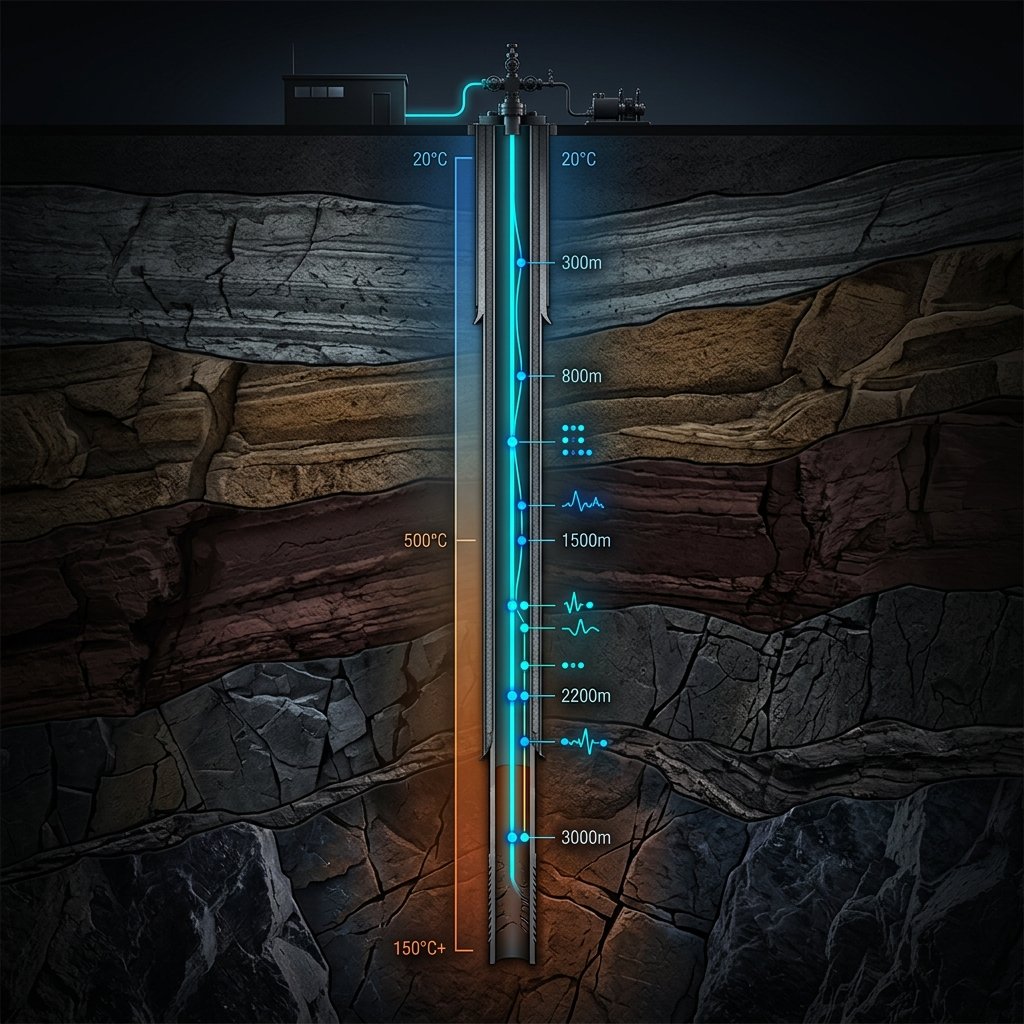
DTS systems measure temperature continuously along the entire fiber length by analyzing the ratio of Stokes and anti-Stokes Raman backscatter signals — which are uniquely sensitive to local temperature.
This delivers a complete temperature profile with ±0.1°C accuracy at sub-meter spatial resolution — ideal for wellbore temperature profiling, pipeline hot spot detection, power cable thermal monitoring, and fire detection.
High-Precision Temperature Profile
±0.1°C accuracy at every measurement point — providing unprecedented insight into thermal behaviour along infrastructure.
Extreme Environment Versions
High-temperature sensing fiber capable of operating in environments up to 300°C for geothermal and industrial applications.
Hot Spot & Fire Detection
Rapidly detect overheating in power cables, conveyor systems, and tunnel environments — preventing catastrophic failures.
DTS Technical Specifications
Need a Custom Sensing
Solution?
Our technical team is ready to help you select and configure the right sensing technology for your specific application.